

At FRM we have worked across 5 continents on waste management projects (haven’t worked in Antarctica or South America yet!), and closer to home, we are also developing 5 waste & resources policy timelines (for CIWM) on the 4 devolved administrations and the EU.
So, we have a good feel for policy, services and operations in different contexts. That last point is crucial, the context is the key when seeking policy measures for a country. It is for this reason that we feel that the developments on harmonising the recyclables collected (through Simpler Recycling), the measures around the Plastics Packaging Tax, mandatory labelling for recycling, and Extended Producer Responsibility (EPR) for Packaging are positive contributions to a well-developed waste management system, in need of driving forward to better resource management and circular thinking.
However, we have real concerns over the pursuit of a Deposit Return Scheme (DRS) in the UK for single use drinks containers (of plastic and metal only). DRS schemes works well in some countries (but not all), and in our view is a poor use of limited financial resources in a UK context. The introduction of a new (duplicate) set of infrastructure collecting the same materials already legislated to be collected from every household and business, and (which would otherwise) be covered by EPR is a sledgehammer to crack a nut, and that sledgehammer could be better used for other aspects of municipal waste management – education, communication, communities, repair schemes, libraries of things and refill / reuse systems.
One benefit often touted of DRS is litter prevention, this will be largely a positive effect (albeit relatively small, as our local litter pick gave a glimpse) but DRS has also been shown to have negative effects in this regard through ‘litter bin diving’ to collect DRS material meaning litter strewn around bins, and with people carrying large nets of plastics bottles and cans on their backs for redeeming at a reverse vending site. Surely not in the UK you may think, and yes we have seen this (see image) in our work in Tanzania for example, but have also observed in the heart of Vancouver. It is worth noting that the collection in Tanzania is due to material value (not a DRS), and also that in British Columbia the DRS was introduced back in 1970. It made sense to have a DRS in the UK in 1970, but not in 2020s when our collection systems are well-established (if needing a nudge to be more efficient and effective in places – i.e. better uses of the sledgehammer).
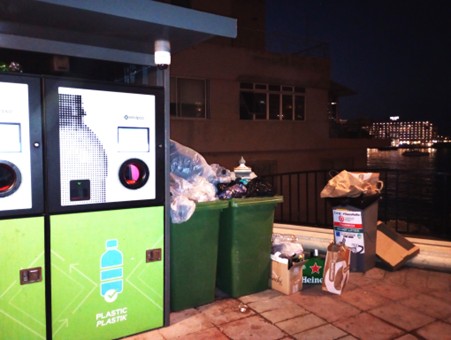
Creating more movements of waste, whether from Reverse Vending Machines to central points for onward transport, or from residents saving up eligible material for a trip to the RVM, creates additional unnecessary environmental burdens for a small environmental benefit. The image below shows DRS material left around a RVM in Malta where we have been working.
Deposit return schemes are an important policy tool for resource management, but in a UK context, in our view, this should be for materials that need it, that don’t already have well used collection systems in place and / or mechanisms for encouraging recyclability, where it can yield real environmental benefits (e.g. some waste electricals, batteries etc).
We could also discuss what to do with collected plastic film post 2027 and Local Authorities paying ETS burdens here, but perhaps save that for another instalment of Waste Across the World!
Frith Resource Management provide waste intelligence, modelling, procurement and strategy work to the public sector in the UK and across the world. See www.frithrm.com or call 01746 552423 or email paul@frithrm.com for details.